

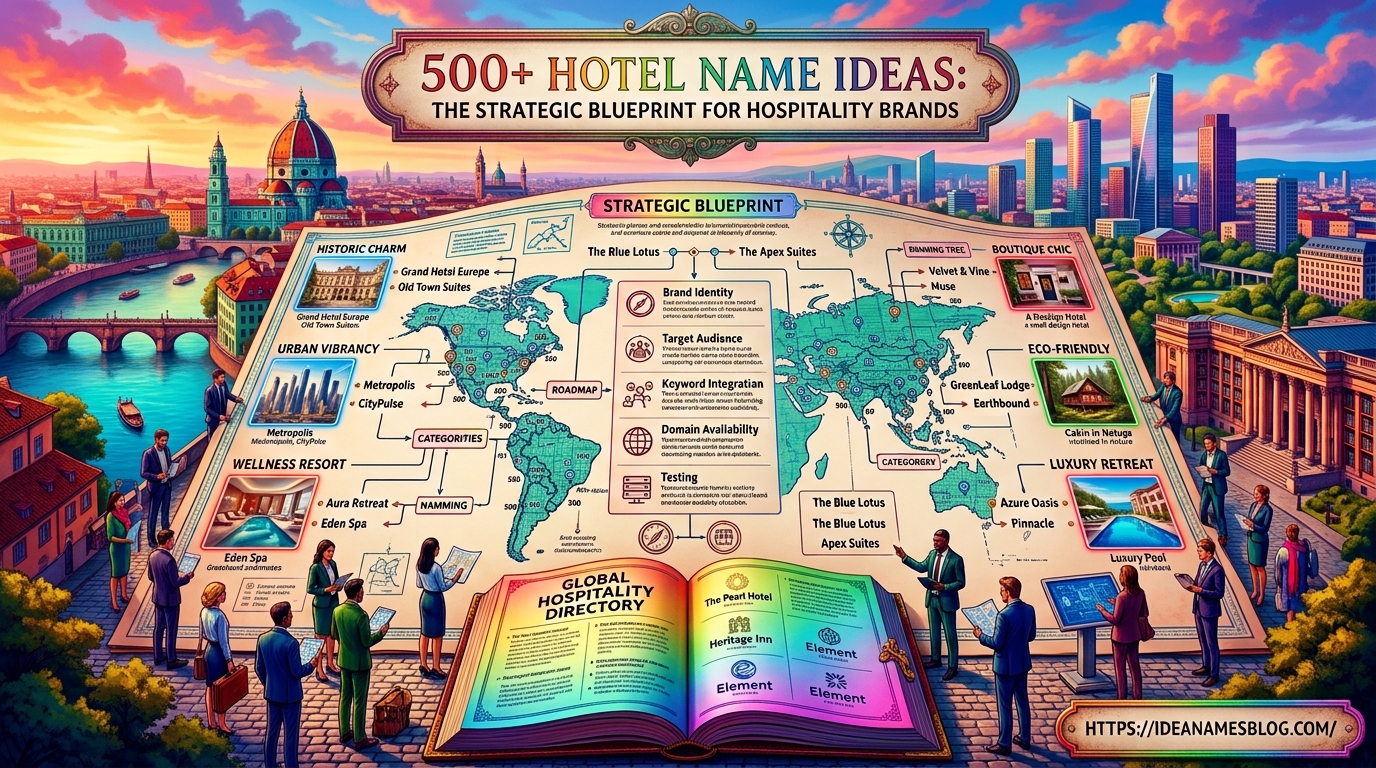
A great hotel name instantly signals luxury, comfort, location, or vibe before a guest ever steps into the lobby or reads a single review. To name a hotel effectively, blend evocative linguistic triggers (like softness or stature) with geographical hints, ensuring the domain is available and the trademark is clear. Hotel name ideas are discussed under below.
Here is the cold truth: generic name lists online are filled with recycled, uninspired ideas that will get your hotel buried on Page 5 of Google or stuck in trademark litigation.
Choosing a name isn’t a creative exercise—it is a positioning decision. The right name lowers your customer acquisition costs, boosts direct bookings, and gives your brand instant authority in a crowded hospitality market.
Catchy & Modern Hotel Name Ideas
Modern hotel names lean into brevity, sleek phonetics, and clean aesthetics. They appeal to modern travelers, digital nomads, and lifestyle guests who value design and seamless experiences.
- Aura Stay: Soft, ambient vibe; best for modern boutique hotels.
- Urban Canopy: Blends city living with natural comfort; ideal for eco-luxury downtown stays.
- Velvet & Vine: Evokes sensory indulgence; great for boutique wine-country retreats.
- Nesta House: Cozy, nest-like feel; perfect for mid-range extended stays.
- Lumina Haven: Bright, uplifting tone; works well for modern wellness resorts.
- The Social Palms: Playful, community-focused; built for lifestyle and social hotels.
- Kinetix Suites: Sharp, energetic; targeted at modern business travelers.
- Verve Hotel: Concise, vibrant; ideal for boutique city-center properties.
- The Daily House: Familiar, relaxed atmosphere; great for bed-and-breakfast style boutique properties.
- Pulse Stay: High-energy, central; designed for youth hostels or micro-hotels.
Luxury & Boutique Hotel Name Ideas
Luxury names rely on classical roots, soft consonant sounds, and terms that imply heritage, exclusivity, and sanctuary.
Luxury Hotel Name Concepts
| Name | Emotional Vibe / Symbolism | Ideal Property Type |
|---|---|---|
| The Obsidian Manor | Exclusivity, depth, dark luxury | High-end mountain or city stay |
| Solis Retreat | Sun-drenched, tranquil, warmth | Coastal or desert resort |
| Aurelia Grand | Timeless, golden, classical | Historic 5-star hotel |
| Sanctuary & Stone | Grounded, private, restorative | Wellness and spa retreat |
| Monarch Cove | Regal, coastal, expansive | Oceanfront luxury resort |
| The Velvet Haven | Soft, intimate, premium comfort | Boutique city sanctuary |
- Elysian Pointe: Supreme bliss and coastal grandeur.
- The Creston Grand: Stately, grounded, and traditional.
- Silken Shore: Smooth, effortless seaside luxury.
- Vanderbilt Lodge: Heritage, classic architectural prestige.
- Opus Retreat: Masterpiece-level service and design.
Coastal, Nature & Eco-Resort Hotel Name Ideas
Eco-resorts and coastal stays demand names grounded in natural elements, sensory textures, and geography.
- Tide & Timber: Organic balance of coast and forest.
- Moss & Stone Cabins: Grounded, eco-conscious, deeply peaceful.
- Azure Horizon Resort: Open, oceanfront, expansive.
- Wildwood Eco-Lodge: Rustic, sustainable, immersive nature.
- Breeze & Bluff: Coastal elevation, fresh air, casual luxury.
- Cedar Ridge Hideaway: Mountain isolation, warmth, scent-driven imagery.
- Salty Pine Inn: Unique intersection of forest and sea.
- Terra Coast Resort: Earth-focused, sustainable coastal getaway.
Minimalist & Single-Word Hotel Name Ideas
Single-word hotel names are abstract, memorable, and visually clean on signage and mobile apps.
- Arbor: Natural, structural, sheltering.
- Civic: Central, urban, community-oriented.
- Haven: Direct signal of safety and rest.
- Loom: Woven, crafted, warm interior focus.
- Strata: Layered design, architectural depth.
- Kith: Community, kin, welcoming hospitality.
- Roam: Adventure-focused, lifestyle travel brand.
- Origin: Ground zero for rest and exploration.
The Psychology and Phonetics of Hotel Naming
Why do names like Marriott, Aman, or Ritz-Carlton command authority? It comes down to linguistic engineering.
1. Phonetic Fronting vs. Backing
Words using front vowels (sounds made at the front of the mouth, like ee in “Sleek” or i in “Vista”) convey lightness, speed, and modern minimalism. Words using back vowels (like o in “Stone” or a in “Grand”) convey stability, size, and luxury.
- Luxury brands lean on heavy, resonant consonants ($B$, $D$, $G$, hard $K$) and deep vowels to project permanence.
- Boutique and lifestyle brands favor soft fricatives ($S$, $V$, $Z$) and open vowels for accessibility and calm.
2. Sensory Memory and Spatial Triggers
Travelers search for feelings, not just beds. A name like Tide & Timber triggers immediate sensory associations: scent (pine/salt), texture (rough wood/smooth water), and sound (waves). Micro-doses of imagery make names instantly sticky in human memory.
Strategic Comparison: Name Styles vs. Target Audience
Hotel Naming Style Breakdown
| Naming Style | Brand Personality | Primary Audience | Example |
|---|---|---|---|
| Heritage / Stately | Regal, established, permanent | High-net-worth, business pros | The Crown & Sovereign |
| Modern Abstract | Sleek, tech-enabled, effortless | Gen Z, Millennial, Nomads | Yotel, Sonder |
| Sensory / Natural | Calming, organic, restorative | Eco-tourists, wellness seekers | Driftwood & Dune |
| Location-Anchored | Authentic, local, navigational | Families, sightseers | Beacon Hill Suites |
4 Costly Mistakes When Naming a Hotel
Here is where most founders get tripped up during the naming process:
- Choosing a Geographic Trap: Naming your first location The Miami Modern limits your brand equity if you ever expand to Austin or Chicago. Use atmospheric locational cues rather than explicit city names unless you intend to stay a single-property brand forever.
- Ignoring Search Engine Confusion: If you name your hotel The Beach House, you will never rank organically on Google. You are competing against millions of generic search terms. Pair common words with a unique brand modifier (e.g., Sonder Beach House or The Line Hotel).
- Failing the “Taxi Test”: Tell a driver your hotel name over a noisy phone line. If you have to spell it out twice, the name fails. Avoid complex French or Latin spellings unless your target demographic explicitly demands ultra-traditional luxury.
- Neglecting Trademark Classes: A domain might be available, but is the name trademarked under Class 43 (Services for providing food and drink; temporary accommodation)? Always check your national trademark registry before printing signage.
The 4-Step Hotel Naming Framework
Follow this structured process to move from a raw brainstorm to a fully vetted, launch-ready hotel name.
1.Define Your Core Anchor:Establish positioning before generating words.
Identify your core differentiator. Are you winning on Location, Aesthetic, Wellness, or Price-to-Value? Pick one primary pillar to drive your word association list.
2.Generate Semantic Clusters:Build broad word pools across four categories.
Create four distinct lists of terms:
- Sensory words (Stone, Linen, Velvet, Mist)
- Architectural terms (Manor, Haven, Vault, Canopy)
- Abstract concepts (Solitude, Pulse, Origin, Aura)
- Geographic markers (Bluff, Creek, District, Shore)
3.Combine and Filter:Test combinations against practical usability criteria.
Mix and match across your clusters. Filter every combination through three strict tests:
- Pronunciation: Is it easy to say on the first try?
- Visual Weight: Does it look clean on a building facade and a smartphone app icon?
- Searchability: Can a user type it into Google without autocorrect hijacking the phrase?
4.Perform Digital & Legal Vetting:Verify domain, social handle, and trademark clearance.
Check domain availability (aim for .com or modern TLDs like .co or .stay). Run a preliminary search on the USPTO (or your local intellectual property office) under Class 43.
Frequently Asked Questions
How do I name a boutique hotel versus a chain?
Boutique hotel names should feel hyper-specific, intimate, and storytelling-driven (e.g., The Speakeasy Inn, Linen & Lime). Hotel chains require flexible, scalable names that can adapt across multiple regions and property types without feeling out of place (e.g., Radisson, Hilton, Sonder).
Should I include the word “Hotel” or “Resort” in my legal brand name?
Keep your core brand name flexible, and use descriptors as functional add-ons. For instance, register the brand as Aura, and append Hotel, Suites, or Resort depending on the property type. This structure keeps your brand scalable if you expand into branded residences or hospitality products later.
How much does domain name choice matter for direct bookings?
It matters significantly for direct booking conversion rates. If your primary domain is overly long or uses confusing hyphens, trust drops. If the exact .com is unavailable, use standard hospitality extensions like stay[brand].com, book[brand].com, or [brand]hotels.com.
The 1-Rule Golden Takeaway
Rule #1: A hotel name should describe an experience, not an address.
Locations can change, facilities get renovated, and amenities evolve—but the emotional promise of your brand remains. Pick a name that makes guests feel how they will feel when they step into your lobby.
